
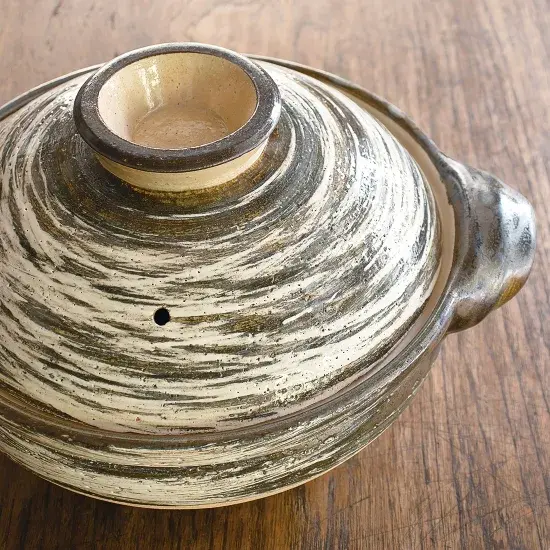

Hakeme is a decorative technique used in Iga earthenware. After applying a thin layer of glaze, a white slip (clay mixed with water) is brushed onto the surface. The brush strokes are intentionally left visible, preserving their natural texture and movement as part of the design.
The energy and rhythm of the brushwork are expressed through the skill of experienced artisans, giving each piece a unique and dynamic character.
Nagatani-en
Crafted by Nagatani-en Iga-ware Pottery, established in 1832, a kiln that produces an array of fun clay pots for every occasion. With “making products we truly want to use” as its motto, the company is devoted to creating objects that are in step with the times, always taking into account evolving cultural trends and lifestyles.
Iga, Rich in Clay and Forests
It is said that Iga-ware got its start in earnest during the Kamakura Period (1185-1333). The Iga region offers high-quality clay and rich red pine forests suitable for firewood. Thus, abundantly blessed with clay and fuel, both indispensable components in earthenware production, Iga became know as a center of pottery production. Up until around 1965, Iga-ware was produced in an ascending kiln fueled by firewood. After 1965, there was a period when both coal and electric kilns were used, but Iga-ware is now mainly fired using a gas kiln that offers great combustibility and thermal efficiency.
Coarse Iga Clay with High Heat-Retaining Capabilities
Iga potter's clay is taken from a geological stratum called the Ancient Biwa Lake Layer, a sedimentary layer rich in the remains of plants and animals that lived 4 million years ago. When the clay is fired at a high temperature, this organic matter is burned out, leaving fine pockets in its place. The resultant highly porous material is coarse to such an extent that it is known as the “clay that breathes,” and its far-infrared rays transfer heat to the core of ingredients cooked in Iga-ware pots. Moreover, Iga clay has high heat-retaining capabilities, making it slow to cool. It retains the same temperature range of simmering at a low flame even when it is removed from the fire, drawing out food's natural umami.A classic donabe in gorgeous hand-painted tokusa* style glaze. Traditionally used for Japanese hot pot meals such as shabu shabu and yosenabe, the Rikyu Tokusa donabe is also an ideal vessel for stewing and braising.
The porous nature of the Iga-sourced clay allows it to retain heat long after being removed from the flame, making it suitable for serving at the table, where it makes for a beautiful presentation as well as a convenient serving bowl. Pair with a Windmill Palm or Rush Trivet to protect your table from heat when serving direct from the stove or oven.
Specifically for use on gas stovetops, over an open flame, or in an oven up to 500°F. Cannot be used on electric stovetops.The finest in Japanese clay cookware, Nagatani-en's non-toxic, single-origin artisan ceramics are all produced in Japan's Iga region, famed for its clay, sourced from the 4-million-year-old Biwa lakebed. This unique porous clay is highly durable, with excellent heat retention, and forms the base for all of Nagatani-en's premium Iga-yaki pottery.
Designed and made in Iga, Japan.